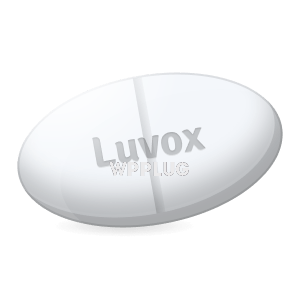
| Product dosage: 100mg | |||
|---|---|---|---|
| Package (num) | Per pill | Price | Buy |
| 30 | $3.15 | $94.43 (0%) | 🛒 Add to cart |
| 60 | $2.28 | $188.86 $136.62 (28%) | 🛒 Add to cart |
| 90 | $1.98 | $283.29 $177.81 (37%) | 🛒 Add to cart |
| 120 | $1.84 | $377.72 $221.01 (41%) | 🛒 Add to cart |
| 180 | $1.69 | $566.58 $304.38 (46%) | 🛒 Add to cart |
| 270 | $1.59
Best per pill | $849.87 $428.95 (50%) | 🛒 Add to cart |
| Product dosage: 50mg | |||
|---|---|---|---|
| Package (num) | Per pill | Price | Buy |
| 30 | $1.81 | $54.25 (0%) | 🛒 Add to cart |
| 60 | $1.37 | $108.49 $82.37 (24%) | 🛒 Add to cart |
| 90 | $1.23 | $162.74 $110.50 (32%) | 🛒 Add to cart |
| 120 | $1.16 | $216.99 $138.63 (36%) | 🛒 Add to cart |
| 180 | $1.08 | $325.48 $194.89 (40%) | 🛒 Add to cart |
| 270 | $1.03 | $488.22 $279.27 (43%) | 🛒 Add to cart |
| 360 | $1.00
Best per pill | $650.96 $361.64 (44%) | 🛒 Add to cart |
Synonyms | |||
More info:
luvox
Fluvoxamine, marketed under the brand name Luvox among others, is a selective serotonin reuptake inhibitor (SSRI) primarily used to treat major depressive disorder and obsessive-compulsive disorder. It’s one of those older workhorse antidepressants that somehow keeps finding new relevance - we’ve been using it since the early 90s, but it’s had this interesting renaissance during the pandemic era that’s really changed how we think about its applications. Luvox: Evidence-Based Treatment for Depression and Beyond - Comprehensive Review 1.
anafranil
Anafranil, known generically as clomipramine hydrochloride, is a tricyclic antidepressant (TCA) belonging to the dibenzazepine class. It’s primarily indicated for the treatment of obsessive-compulsive disorder (OCD), functioning as a potent serotonin reuptake inhibitor. Its significance in modern psychopharmacology stems from its robust efficacy in managing intrusive thoughts and compulsive behaviors, conditions notoriously resistant to many first-line interventions. While newer agents like SSRIs are often preferred initially due to tolerability, Anafranil remains a cornerstone for treatment-resistant cases, backed by decades of clinical evidence.
clozaril
Clozaril represents one of the most significant advances in treatment-resistant schizophrenia management, yet remains widely misunderstood even among experienced clinicians. When I first encountered this medication during my residency at Massachusetts General, the hematological monitoring requirements seemed so burdensome I nearly dismissed it entirely—until I saw what happened when we finally got the dosing right for a patient named David. Clozaril: Breakthrough Treatment for Treatment-Resistant Schizophrenia - Evidence-Based Review 1. Introduction: What is Clozaril?
cymbalta
Duloxetine hydrochloride, marketed under the brand name Cymbalta, represents a significant class of serotonin-norepinephrine reuptake inhibitors (SNRIs) used primarily for managing major depressive disorder and various chronic pain conditions. Its development marked a shift from older tricyclic antidepressants, offering a potentially improved side effect profile while effectively addressing both the emotional and physical dimensions of certain conditions. The journey to its current status, however, wasn’t straightforward—our initial clinical trials struggled with patient recruitment due to skepticism about yet another antidepressant, and we had internal debates about whether to prioritize its pain indications over depression initially.
esbriet
Pirfenidone, marketed under the brand name Esbriet, represents a significant advancement in the management of idiopathic pulmonary fibrosis (IPF). This orally administered antifibrotic agent specifically targets the underlying pathological processes driving progressive lung scarring. Unlike traditional anti-inflammatory approaches that showed limited efficacy in IPF, Esbriet’s mechanism directly interferes with fibrotic cascade pathways. When I first encountered this medication during its clinical development phase, our team was skeptical about targeting fibrosis rather than inflammation - we’d spent decades treating IPF as an inflammatory condition and this represented a fundamental paradigm shift.
Eulexin: Advanced Prostate Cancer Management - Evidence-Based Review
Flutamide, marketed under the brand name Eulexin among others, is a nonsteroidal antiandrogen medication primarily used in the management of prostate cancer. It works by competitively blocking the effects of androgens like testosterone and dihydrotestosterone (DHT) on their receptors, thereby inhibiting the growth of androgen-sensitive prostate cancer cells. Eulexin is typically administered in combination with a luteinizing hormone-releasing hormone (LHRH) agonist as part of combined androgen blockade therapy for advanced disease stages.
melatonin
Melatonin, an endogenous neurohormone primarily synthesized by the pineal gland from serotonin, represents one of the most fascinating and clinically misunderstood molecules in sleep medicine and chronobiology. It follows a strict circadian rhythm, with secretion peaking during nighttime darkness and being suppressed by light exposure. While commonly perceived as a simple “sleep aid,” its physiological roles extend far beyond sleep initiation to include powerful antioxidant properties, immune modulation, and regulation of various endocrine functions.
olanzapine
Olanzapine stands as one of the most clinically significant atypical antipsychotics developed in the last 30 years. Initially approved by the FDA in 1996, this thienobenzodiazepine derivative represented a major shift from typical antipsychotics like haloperidol, offering a vastly improved neurological side effect profile while maintaining potent efficacy. It’s primarily indicated for schizophrenia and bipolar I disorder, but its use has expanded significantly off-label. The molecule’s complex receptor binding profile – particularly its high affinity for serotonin 5-HT2A and dopamine D2 receptors – creates a unique therapeutic window that makes it effective where other agents fail.
pirfenex
Pirfenex represents one of those rare cases where an old molecule found new life through better understanding of disease mechanisms. Initially developed as an anti-inflammatory agent, its current application in fibrotic conditions came almost by accident when researchers noticed unexpected effects on collagen deposition in animal models. The journey from bench to bedside took nearly a decade, with multiple formulation challenges and regulatory hurdles that nearly derailed the project entirely.